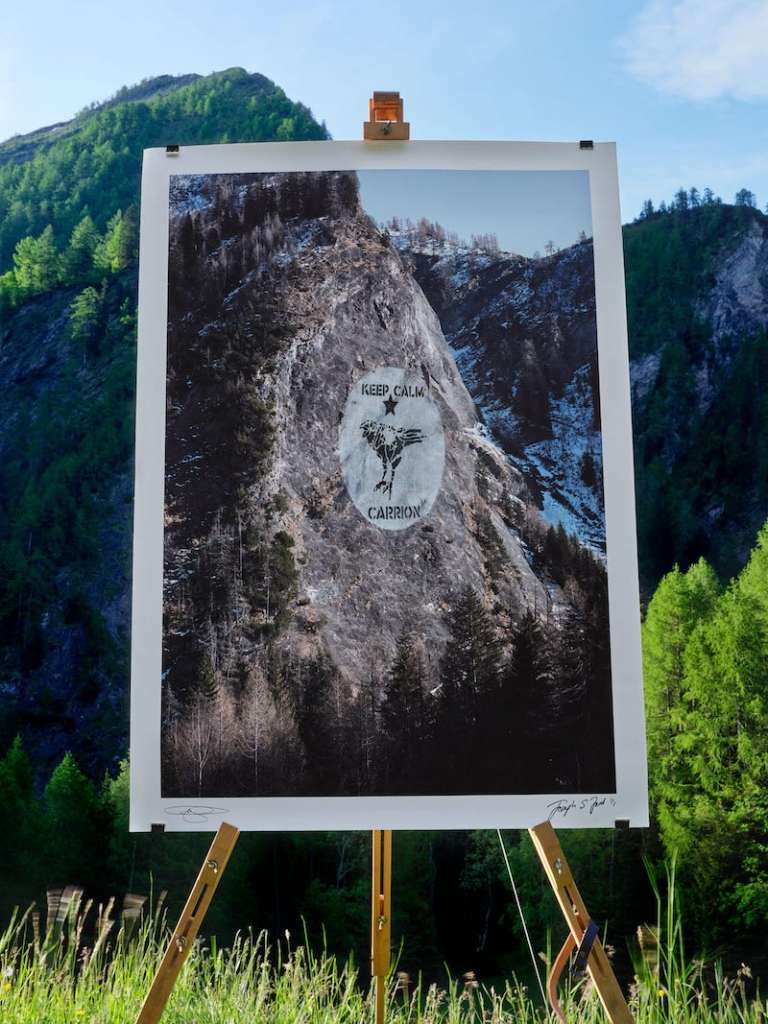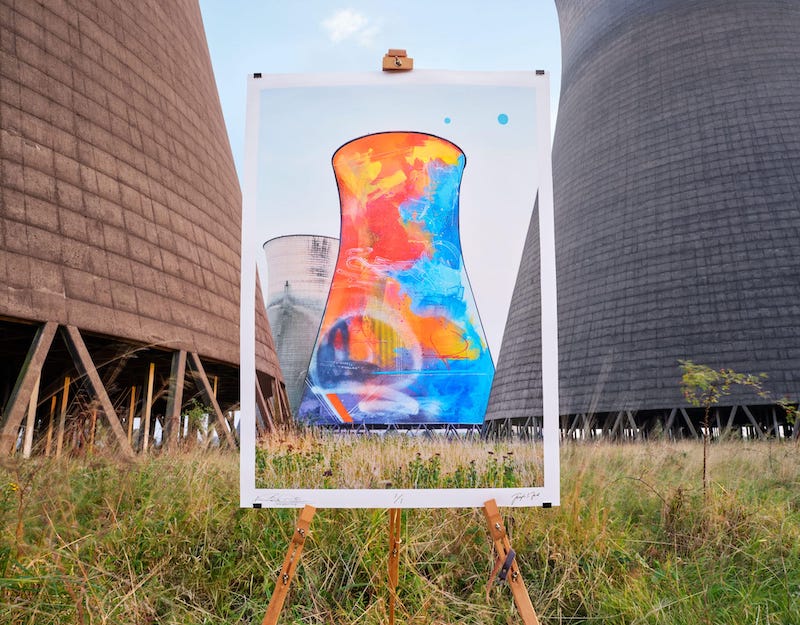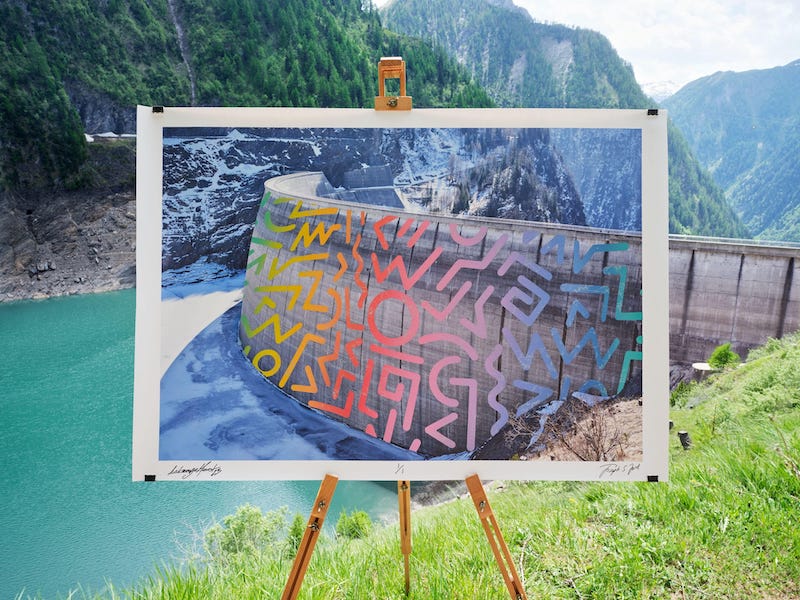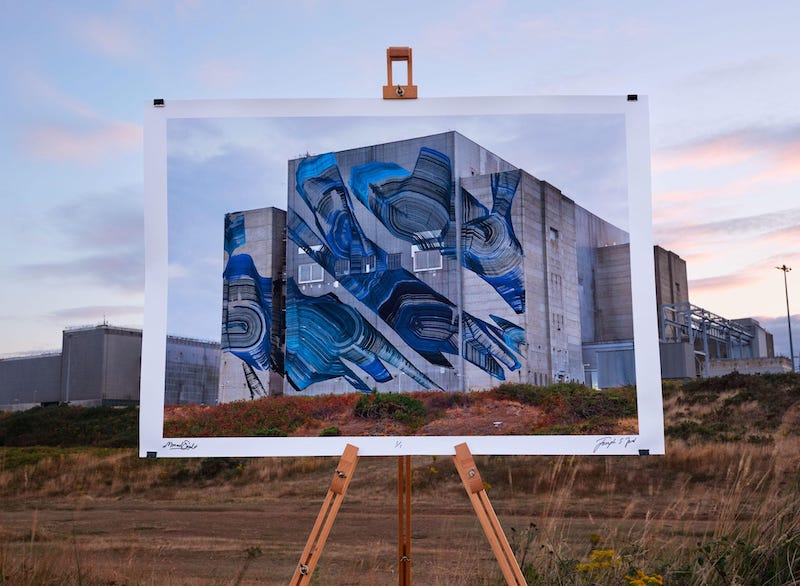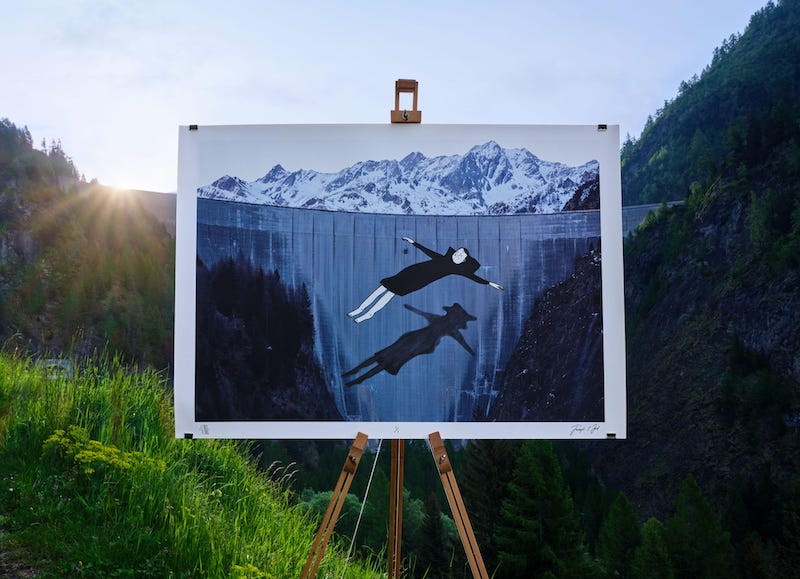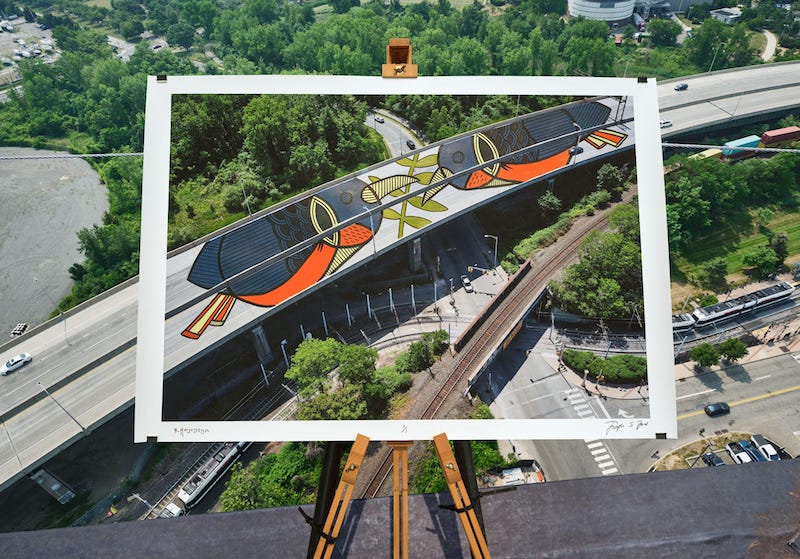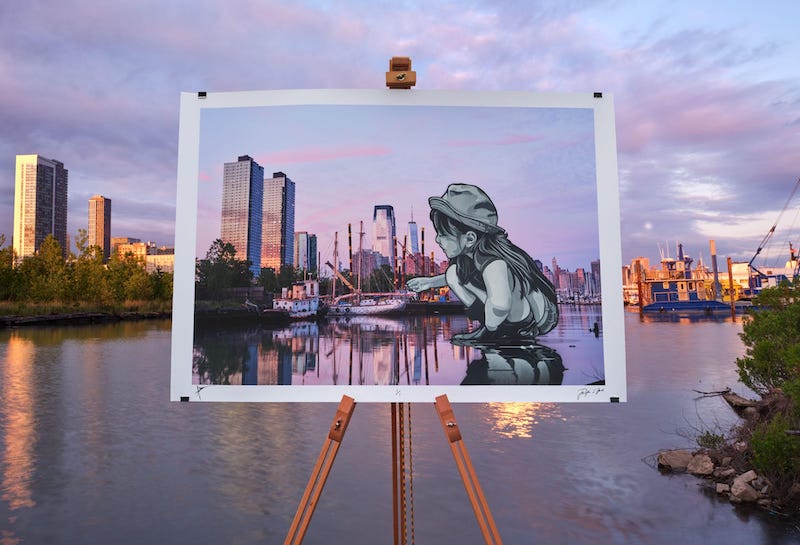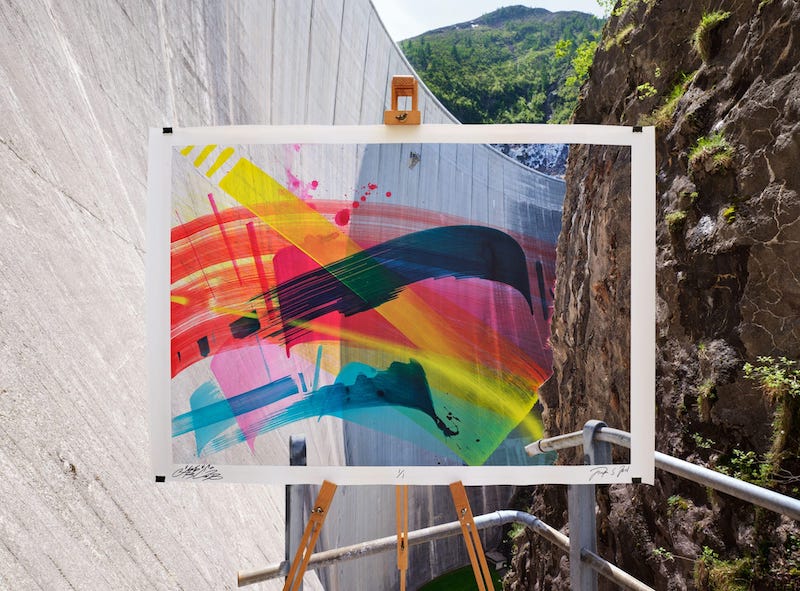
There is a quiet provocation embedded in Joseph Ford’s Impossible Street Art series, one that does not rely on spectacle so much as it repositions the viewer’s relationship to scale, access, and authorship. At a glance, the works appear playful—street art imagined at an almost absurd magnitude, stretched across dams, power plants, and industrial complexes. But beneath that initial impression sits a more pointed question: who gets to interact with the structures that dominate the modern landscape, and who is left to simply look at them from a distance?
Ford, best known for conceptual photography projects that blur perception and reality, has built a practice around subtle interventions. His earlier work often relied on visual trickery that encouraged viewers to pause, reconsider, and ultimately recalibrate what they thought they were seeing. Impossible Street Art extends that methodology, but with a sharper focus on environment and infrastructure. The series brings together artists such as Antonyo Marest, Alex Senna, MadC, and Skirl, inviting them to “paint” monumental works across sites that are, by design, inaccessible.
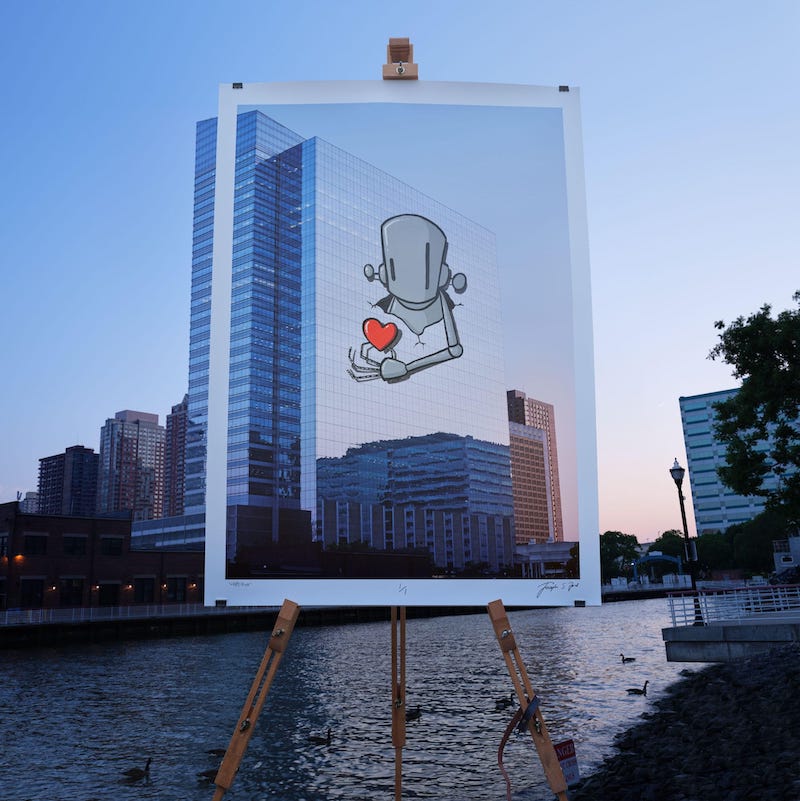
The process itself is deceptively simple. Ford captures photographs of vast industrial or infrastructural locations—nuclear power stations, hydroelectric dams, port facilities—and then collaborates with artists to digitally superimpose large-scale interventions onto those images. The final twist comes in the presentation: these altered photographs are displayed on an easel placed directly in front of the real-world site, creating a layered illusion that collapses the distance between concept and reality. The viewer is left with a strange, compelling tension between what exists and what could exist.
Infrastructure as an Unwilling Monument
Modern infrastructure has a peculiar presence. It is everywhere, yet rarely engaged with in any meaningful way. Power plants, highways, and industrial complexes define the physical and economic landscapes of entire regions, but they remain largely inaccessible to the public. They are visible, often unavoidable, but not participatory. This paradox is central to Ford’s project.
By introducing street art into these environments—even if only through photographic illusion—Impossible Street Art reframes these structures as potential sites of cultural expression. It is a gesture that feels both speculative and critical. The works do not suggest that these interventions will ever be realized at scale. Instead, they ask what it would mean if they could be.
This question carries particular weight in the context of energy production. Many of the locations featured in the series are tied to systems that power daily life while remaining physically and conceptually distant from it. Nuclear facilities, fossil fuel plants, and hydropower systems operate at a scale that resists intimacy. They are engineered to function efficiently, not to invite engagement.
Ford’s interventions disrupt that dynamic, if only momentarily. By placing art onto these surfaces, he creates a visual language that humanizes structures often perceived as abstract or impersonal. The result is not a transformation of the sites themselves, but a shift in how they are perceived.
Collaboration as Expansion
The collaborative nature of Impossible Street Art is essential to its impact. Ford does not impose a singular aesthetic onto these landscapes. Instead, he invites artists with distinct visual languages to interpret the sites in their own ways. Antonyo Marest’s vibrant geometries, Alex Senna’s monochromatic figures, and MadC’s dynamic color fields each bring a different perspective to the same underlying concept.
This diversity reinforces the idea that these spaces, while currently inaccessible, could support a wide range of cultural expressions. It also underscores the adaptability of street art as a medium. Traditionally associated with urban environments, street art here is transposed onto rural coastlines, industrial zones, and infrastructural corridors, expanding its conceptual reach.
There is also a subtle commentary on authorship embedded in this approach. By working collaboratively, Ford positions himself not as the sole creator, but as a facilitator of ideas. The final images are the result of multiple perspectives intersecting, each contributing to a larger narrative about space, access, and imagination.
Trompe-l’œil as Method and Message
The use of trompe-l’œil techniques is more than a stylistic choice. It is integral to how the series operates. By creating illusions that appear almost plausible, Ford blurs the line between documentation and fabrication. The viewer is encouraged to question what is real, but also to consider why the imagined version feels compelling.
This interplay between reality and illusion mirrors the broader themes of the project. Infrastructure, in many ways, is already a kind of illusion—systems that appear static and permanent but are constantly in flux, shaped by economic, political, and environmental forces. By overlaying art onto these structures, Ford makes that instability visible, even if only conceptually.
The easel presentation adds another layer to this dynamic. It situates the artwork within the physical space it references, creating a dialogue between the photograph and the site itself. The viewer is not simply looking at an image; they are standing within the context of that image, experiencing the gap between reality and possibility firsthand.
Environmental Context and Cultural Tension
Many of the locations featured in Impossible Street Art are not neutral backdrops. They are sites of ongoing environmental and social tension. The nuclear power station depicted in Skirl’s contribution, for example, is situated near a protected landscape on England’s east coast, where debates about expansion and ecological impact continue to unfold.
By placing art within these contexts, Ford does not offer solutions, but he does create space for reflection. The interventions draw attention to the scale and presence of these structures, encouraging viewers to consider their role within the broader environment. It is a subtle form of critique, one that avoids overt messaging in favor of visual suggestion.
There is also an element of reclamation at play. These sites, while physically public, are functionally restricted. They exist within shared landscapes but are not accessible in the ways parks, streets, or public squares are. By imagining them as canvases, Ford and his collaborators challenge that limitation, proposing an alternative relationship between infrastructure and community.
Street Art Beyond the Street
The title Impossible Street Art carries a certain irony. Street art, by definition, is rooted in accessibility. It is meant to be encountered in everyday environments, integrated into the rhythms of urban life. By placing it onto inaccessible infrastructure, Ford highlights the boundaries that define where art can and cannot exist.
At the same time, the series expands the definition of street art itself. It suggests that the “street” is not a fixed location, but a concept—one that can be extended, reinterpreted, and challenged. In doing so, it aligns with a broader trend in contemporary art, where traditional categories are increasingly fluid.
This expansion is not without its contradictions. The works are, ultimately, photographic illusions rather than physical interventions. They do not alter the sites they depict, nor do they grant actual access to them. Yet this limitation is part of what makes the series compelling. It operates within the space between reality and imagination, using that gap to explore ideas that might otherwise remain abstract.
A Practice Rooted in Perception
Joseph Ford’s work has always been concerned with how people see and interpret the world around them. Impossible Street Art continues that exploration, but with a sharper focus on the structures that shape daily life. It invites viewers to look at familiar landscapes in unfamiliar ways, to consider not just what is there, but what could be.
There is a certain restraint in this approach. The series does not rely on overt spectacle or dramatic gestures. Instead, it builds its impact through accumulation—image by image, intervention by intervention. Each work adds to a larger conversation about space, access, and the role of art in engaging with both.
In a cultural moment often defined by immediacy and excess, this kind of measured provocation feels particularly relevant. It does not demand attention so much as it earns it, drawing viewers in through curiosity rather than force.
For those interested in exploring Joseph Ford’s Impossible Street Art series further, additional works and updates can be found through his official social channels and portfolio.