There is an oddly persistent sameness to the portable Bluetooth speaker.
The category has spent years becoming louder, tougher and more technically competent, but its basic visual formula remains remarkably predictable: rounded rectangle, dark grille, rubberized controls, perhaps a splash of color if somebody in product development is feeling adventurous.
CMF has apparently looked at that landscape and decided the Bluetooth speaker could stand to loosen its collar.
The design-focused brand associated with Nothing is entering portable audio with the CMF Speaker S and CMF Speaker M, two new wireless speakers that treat color, physical controls and personalization as seriously as output power and battery life.
Launching October 12, 2026, the pair starts at $59 for Speaker S and $109 for Speaker M, putting both firmly into one of consumer electronics’ most competitive categories.
Instead of trying to disappear into that crowd, CMF has made speakers that look conspicuously like CMF products.
That may be their biggest advantage.
Two Speakers, One Very Recognizable Design Language
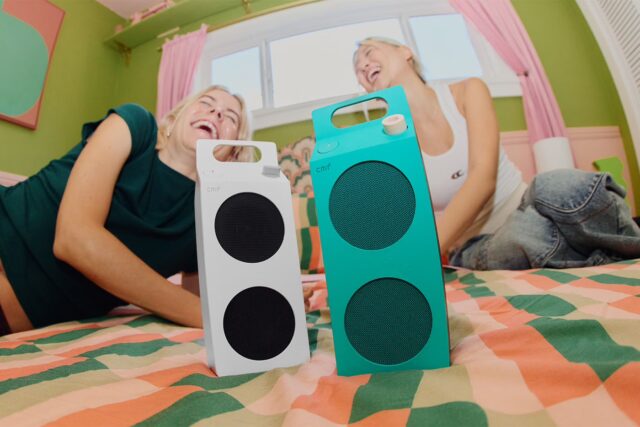
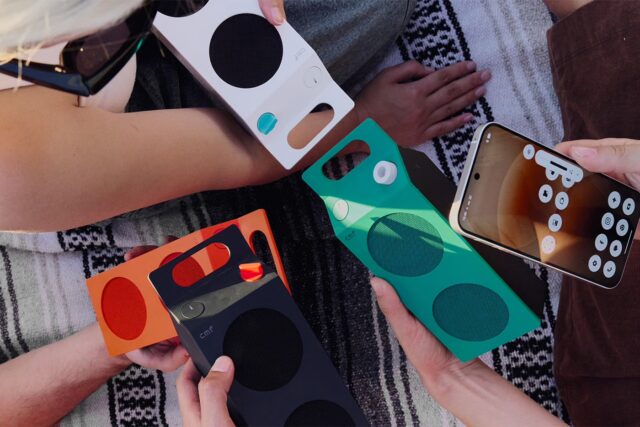
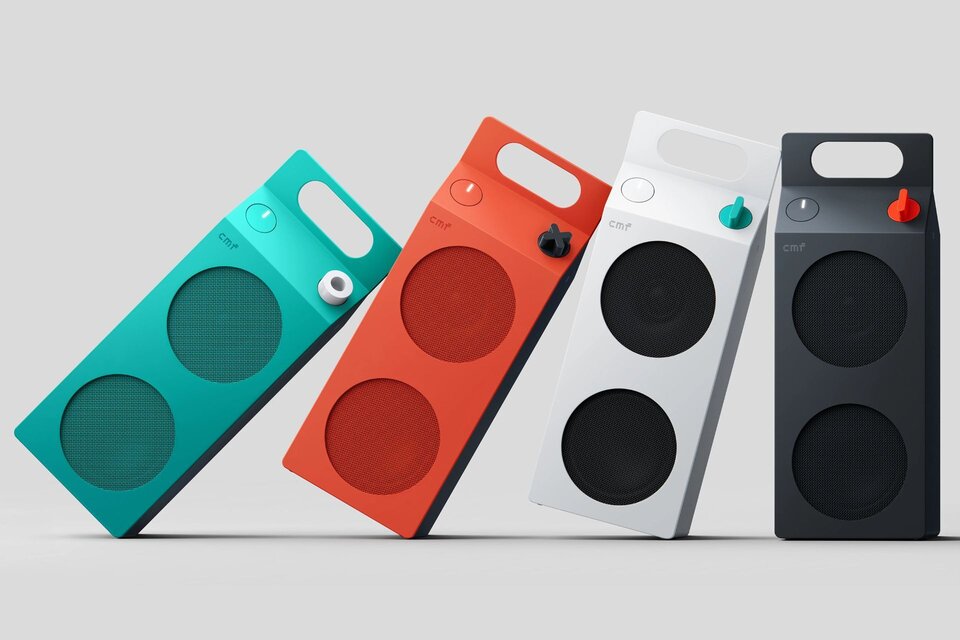
Speaker S and Speaker M share the same basic architectural idea: upright geometric bodies, strong blocks of color, prominent physical controls and removable components that invite the owner to interact with the object rather than simply pair it once and forget about it.
Both arrive in White, Dark Grey, Orange and Turquoise.
Those colors are not treated as minor trim options. They are fundamental to the speakers’ personalities.
CMF has also designed the front panels and control knobs to be replaceable, continuing the modular approach that has become part of the company’s broader industrial-design identity. Standardized components intended to support 3D-printable variations push that idea beyond choosing one factory color at checkout.
In other words, the speaker does not necessarily have to look the same six months after purchase as it did when the box was opened.
That sounds like a small distinction until one considers how disposable the aesthetics of inexpensive electronics have become.
CMF is proposing something slightly different: the affordable gadget as an object worth modifying.
Speaker S Is the Grab-It-and-Go Option
The CMF Speaker S is the smaller of the pair.
It measures approximately 130.5 mm tall, 85 mm wide and 44 mm deep, weighs 334 grams and incorporates a utility hook that makes it easy to attach to a bag, strap or carabiner.
Its sharp, almost carton-like proportions give it more visual character than the usual cylindrical travel speaker without sacrificing portability.
Inside is a 45 mm full-range driver producing 10W RMS, assisted by two passive radiators. CMF specifies a frequency response of 70 Hz to 20 kHz.
The engineering brief here is straightforward: make something small enough to travel easily without stripping away the bass response and physical presence listeners expect from a modern wireless speaker.
It is the sort of format that makes sense clipped to luggage, sitting beside a picnic blanket or occupying the increasingly crowded corner of a desk.
Speaker M Turns the Same Idea Up to 35 Watts
The Speaker M uses essentially the same design vocabulary but gives it significantly more muscle.
At 220 mm tall, 85 mm wide and 54 mm deep, with a weight of 602 grams, it moves closer to a compact room speaker while remaining genuinely portable thanks to an integrated handle.
The major difference is inside.
Rather than relying on one full-range driver, Speaker M uses a 70 mm woofer and 16 mm tweeter, producing 25W and 10W RMS respectively for 35W RMS total output.
Its rated frequency response stretches from 60 Hz to 20 kHz.
The two-driver arrangement matters because it allows the speaker to divide frequencies between dedicated components rather than asking one driver to reproduce everything at once.
On paper, that should translate into stronger low-end presence, better separation and clearer reproduction of voices and higher-frequency detail than the smaller Speaker S.
Speaker M is therefore the obvious choice for somebody primarily planning to use the speaker around an apartment, bedroom, studio or patio while still wanting something easy enough to pick up and carry elsewhere.
CMF Has Not Forgotten That These Things Need to Sound Good
The playful exterior might be the first thing people notice, but CMF has given both speakers a fairly serious collection of playback features.
There is Adaptive Tuning, designed to make continuous hardware-level adjustments to playback, alongside Ultra Bass, Wide Soundstage and customizable EQ.
Through the Nothing X app, listeners can choose presets including Balanced, More Bass, More Treble and Voice, or create their own custom equalization.
That flexibility is becoming increasingly important in portable audio.
A Bluetooth speaker might spend the morning quietly streaming a podcast, the afternoon playing music outdoors and the evening handling a movie from a laptop. A single permanently tuned sonic profile does not necessarily make sense for all three.
CMF appears to understand that.
Stereo Mode and Auracast Make the Speakers More Interesting in Groups
Both Speaker S and Speaker M support Stereo Mode, allowing two matching speakers to operate as dedicated left and right channels.
That distinction is important.
Two speakers playing the same audio simultaneously can increase volume. A properly divided left-and-right setup can actually expand the stereo image.
CMF also supports Auracast, the Bluetooth broadcast technology increasingly appearing across modern audio hardware.
Its Party Mode allows compatible speakers to receive synchronized playback, providing a much more flexible route to multi-speaker listening than older proprietary systems that frequently locked consumers into one brand’s ecosystem.
Auracast compatibility can also extend beyond CMF hardware when used with other supported devices.
That quietly gives these relatively inexpensive speakers a more forward-looking connectivity story than their prices might suggest.
Bluetooth 6.0, NFC and USB-C Cover the Practical Stuff
CMF has resisted the temptation to make customization the entire story.
The connectivity package is unusually comprehensive for the price.
Both models support Bluetooth 6.0, dual-device connections, NFC pairing, Google Fast Pair and Microsoft Swift Pair.
A USB-C connection can also handle audio playback with latency rated below 60 milliseconds, making the speakers considerably more useful beside a laptop or desktop computer.
CMF lists an open-space Bluetooth range exceeding 100 meters, although real-world range will naturally vary with walls, interference and the devices being connected.
The USB-C audio option is particularly welcome.
Bluetooth is convenient. A cable remains wonderfully uncomplicated.
The Knob Might Be the Best Feature
There is something satisfying about a product that still understands the human hand.
Rather than burying everything inside an app, CMF gives both speakers a prominent physical knob controlling playback, track navigation and volume.
Holding the knob can also toggle Ultra Bass.
Separate buttons handle power, Bluetooth pairing and Auracast.
It is not revolutionary technology.
It may nevertheless be one of the speakers’ most appealing characteristics.
Consumer electronics spent much of the past decade replacing tactile interfaces with touch panels and menus. CMF’s approach acknowledges that sometimes a knob is simply better.
Turn right. Music gets louder.
Civilization survives another day.
IP68 Protection Makes the Colorful Design Less Precious
Brightly styled products occasionally look as though they should remain safely indoors.
These do not.
Both Speaker S and Speaker M carry an IP68 water- and dust-protection rating, giving the lineup real credibility as outdoor equipment rather than merely attractive desk accessories.
Battery life is rated at up to 18 hours with Ultra Bass enabled at 50 percent volume.
Speaker S carries a 2,600 mAh battery and requires approximately 2.5 hours for a full wired charge. Speaker M increases capacity to 4,900 mAh and takes roughly three hours.
Both support quick charging that can provide approximately one hour of playback from a 10-minute charge under CMF’s specified test conditions.
That combination—rugged construction, long battery life and genuinely portable dimensions—makes the design experimentation easier to appreciate because it has not come at the expense of basic utility.
Why CMF’s First Speakers Matter
The most interesting thing about Speaker S and Speaker M is not any single technical specification.
It is the philosophy connecting them.
Affordable electronics have become enormously capable while simultaneously becoming strangely anonymous. Entire product categories now compete around nearly identical rectangles differentiated by specification sheets and increasingly microscopic performance advantages.
CMF is betting that personality still matters.
Color matters.
Touch matters.
The ability to modify something after buying it matters.
And perhaps people would prefer their speaker not to resemble a piece of airport security equipment.
The strategy fits neatly within a larger shift happening throughout consumer technology, where customization is once again becoming a meaningful product feature rather than an aftermarket hobby.
Replaceable pieces, downloadable designs and standardized components can give relatively inexpensive hardware a longer cultural lifespan. Instead of simply replacing a device when its aesthetic becomes stale, users can potentially change it.
That is a far more interesting proposition than introducing another limited-edition paint color every six months.
Speaker S or Speaker M?
The decision between the two is refreshingly simple.
Choose Speaker S if portability matters most. At $59, its 334-gram body, hook, 10W output and 18-hour battery rating make it the more natural everyday travel companion.
Choose Speaker M if sound output takes priority. For $109, its 35W dual-driver system, dedicated woofer and tweeter, larger battery and integrated handle make considerably more sense for rooms, gatherings and listeners who want stronger bass performance.
Everything else—the IP68 protection, customization, app-based EQ, Auracast, Stereo Mode, NFC pairing, Bluetooth 6.0 and USB-C playback—is shared.
That consistency is smart.
CMF is not asking customers to buy the expensive speaker to unlock the interesting features. It is primarily asking them to choose how much speaker they actually need.
CMF Gives the Bluetooth Speaker Some Personality Again
Neither Speaker S nor Speaker M attempts to reinvent portable audio.
They do something subtler.
They make the category look enjoyable again.
The bold colors, modular pieces, physical knob and almost architectural silhouettes suggest that useful technology does not have to retreat visually into the background. Meanwhile, IP68 construction, up to 18 hours of playback, modern wireless standards and surprisingly sophisticated multi-speaker support keep the products grounded in practical engineering.
At $59 and $109, CMF has positioned its first speakers where design experimentation rarely survives aggressive pricing.
That makes the lineup worth watching.
The CMF Speaker S and CMF Speaker M are available beginning October 12, 2026 in White, Dark Grey, Orange and Turquoise.
Readers can browse the complete CMF lineup at usnothing.tech.